Artificial intelligence voicebots have moved from futuristic novelty to everyday business powerhouse. These virtual agents AI (agentes virtuales IA) not only answer calls, resolve issues, qualify leads, schedule appointments, and deliver personalized support around the clock, but also enhance customer engagement AI by creating seamless, interactive experiences that feel natural, intelligent, and human.
For organizations of every size, an artificial intelligence voicebot is now a practical way to scale customer interactions without sacrificing quality. By combining speech recognition, natural language understanding, and intelligent automation, businesses can handle high call volumes efficiently, accurately, and consistently. Beyond direct customer service, AI voicebots are increasingly integrated into cloud-based collaboration platforms that allow teams to access real-time data, coordinate operations across multiple locations, and respond faster to customer needs, creating a flexible, scalable infrastructure for modern business.
In addition, these voicebots are part of advanced computer technology systems that analyze vast amounts of information, identify patterns, and provide actionable insights, enabling organizations to make smarter, data-driven decisions. In marketing, AI voicebots support intelligent campaign management solutions that study customer behavior, segment audiences, and deliver personalized messages at the right time, while digital marketing initiatives now leverage AI to optimize website interactions, social media engagement, and content delivery based on real-time analytics.
The impact of AI voicebots also extends to finance, where they contribute to automated financial workflows that handle repetitive tasks, monitor transactions for errors or anomalies, and generate predictive reports to guide strategic planning, freeing human teams to focus on higher-value work. By connecting customer service with marketing intelligence, operational technology, and financial insights, businesses can create a seamless ecosystem where AI voicebots are a central, intelligent hub that drives efficiency, engagement, and growth.
This guide explains what an artificial intelligence voicebot is, how it works, the business benefits, and how to successfully implement one in your organization.
Top 10 Artificial Intelligence Voicebot and AI-Powered Contact Center Solutions for Modern Customer Engagement
1. Bright Pattern — A Full-Featured AI Contact Center Hub
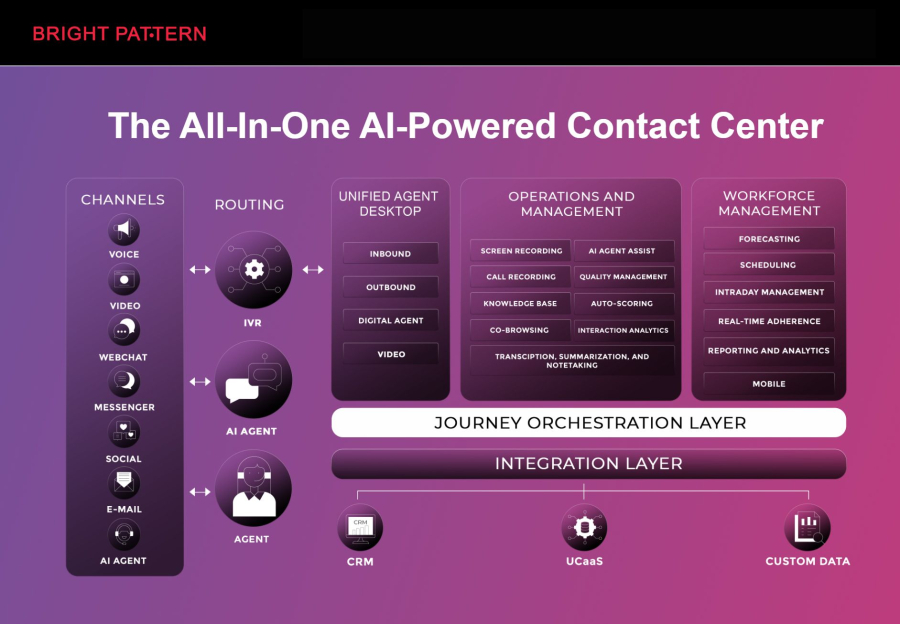
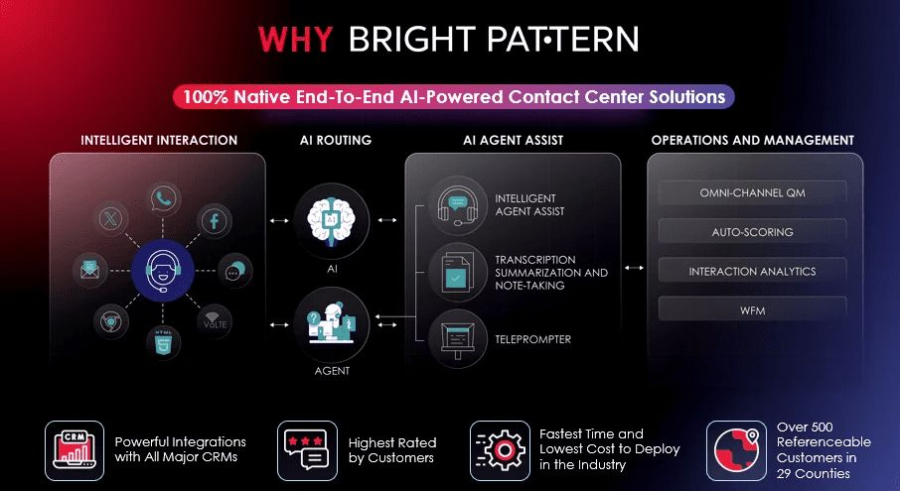
Bright Pattern offers a cloud-based, omnichannel contact center platform built around powerful AI and automation — designed to serve as a central hub for modern customer support and engagement.
- Omnichannel support & unified communications: Handles voice calls, chat, email, video, and SMS, allowing customers to switch seamlessly between channels while preserving context.
- AI-driven virtual agents and automation: Leverages AI for virtual agents (voice and chat bots), conversational IVR, and self-service, automating FAQs and common requests around the clock.
- Intelligent call routing & predictive distribution: Uses AI to analyze language, intent, sentiment, and customer history to route interactions to the best-suited agent or virtual agent automatically.
- Real-time agent assist & analytics: Provides live suggestions, next-best actions, relevant knowledge base articles, and emotional/contextual cues during interactions, making support faster and smarter.
- Scalability and cloud-based deployment: Integrates smoothly with CRMs and enterprise systems, enabling easy scaling as business needs grow.
In short, Bright Pattern provides a robust, AI-powered platform that combines automation, human-agent collaboration, and omnichannel flexibility for businesses aiming to modernize their contact center operations.
2. NICE CXone
NICE CXone blends advanced AI analytics and automation with broad contact center capabilities. It’s ideal for large enterprises looking to scale support, improve customer engagement, and optimize agent performance.
3. Genesys Cloud CX
Genesys Cloud CX provides a comprehensive omnichannel contact center solution with intelligent routing, predictive engagement, and agent-assist features — enabling businesses to personalize each customer interaction efficiently.
4. Five9
Five9 offers a cloud-based contact center platform with AI-powered virtual agents, automation, and tools to improve first-call resolution while reducing wait times. It is well-suited for companies needing a scalable, flexible solution.
5. Talkdesk
Talkdesk combines conversational AI and workflow automation to streamline customer interactions across multiple channels. Its intuitive interface and consistent service delivery help teams provide faster, high-quality support.
6. Dialpad AI Contact Center
Dialpad’s platform brings together voice, chat, and other communication channels in a single app. Features include sentiment analysis, high-accuracy voice transcription, and AI-powered coaching for agents, making it ideal for teams prioritizing mobility and cloud-native simplicity.
7. Aircall
Aircall is a cloud-based contact center solution that supports IVR, call routing, queue callback systems, and shared inboxes for calls and messages. It is often chosen by small to medium-sized businesses for its ease of use and flexibility.
8. Avaya Contact Center (Cloud/Modern)
Avaya has evolved from traditional telecom systems to offer cloud-based contact center solutions. Features include real-time speech recognition, transcription, and intent recognition capabilities to improve support workflows and agent performance.
9. RingCentral Contact Center
RingCentral provides cloud-native, omnichannel contact center capabilities. Its platform is designed for flexibility, scalability, and integration with unified communications tools, making it suitable for businesses that want a modern, all-in-one solution.
10. Freshdesk Contact Center
Freshdesk Contact Center appeals to smaller businesses or teams needing essential contact center functions — such as call routing, CRM integration, and workflow automation — without the complexity or cost of enterprise-grade platforms.
What Is an Artificial Intelligence Voicebot?
Anartificial intelligence voicebotis a software agent that can understand spoken language, respond with natural-sounding speech, and complete tasks or provide information automatically. Unlike traditional phone menus that force callers to "press 1 or 2," a voicebot lets users speak naturally, just as they would to a human agent.
Key capabilities of modern AI voicebots include:
- Speech recognitionthat converts a caller's voice into text.
- Natural language understandingthat interprets the intent behind the caller's words.
- Dialogue managementthat decides what to say or do next.
- Text-to-speechthat generates fluent, human-like audio responses.
- System integrationsthat allow the voicebot to access data, trigger workflows, and update records.
In short, an AI voicebot is like a smart virtual agent for voice channels, available 24/7 and ready to scale to thousands of conversations at once.
How an AI Voicebot Works: From "Hello" to Resolution
While modern voicebots feel simple to users, there is a powerful stack of AI technologies working under the surface. Here is a simplified step-by-step look at what happens during a typical interaction.
1. Call initiation and greeting
A customer calls a phone number or taps a call button inside an app. Instead of a static IVR menu, they are greeted by an AI voicebot. The voicebot might say something like, "Hi, how can I help you today?" and then listen.
2. Speech recognition
The voicebot captures the caller's audio and runs it throughautomatic speech recognition(ASR). The ASR engine turns the sound waves into text, often with specialized dictionaries and acoustic models tuned for accents, product names, and industry terms.
3. Intent detection and understanding
Next,natural language understanding(NLU) analyzes the text to determine what the caller wants to achieve. This involves:
- Identifying theintent(for example, "check order status" or "reset password").
- Extractingentitieslike names, dates, and account numbers.
- Recognizing context from previous turns in the conversation.
The result is a structured representation of the caller's request that the system can act on.
4. Business logic and integrations
Once the voicebot understands the intent, it consults predefineddialogue flowsandbusiness rules. It may:
- Authenticate the user.
- Query a CRM or ticketing system.
- Trigger an API call to check balances, change reservations, or open a support case.
- Route the call to a human agent if needed.
The voicebot can orchestrate multiple steps, asking follow-up questions if it needs more information to complete the task.
5. Natural-sounding response
After deciding what to say, the system uses atext-to-speech(TTS) engine to generate the spoken response. Modern TTS can produce highly natural, expressive speech with controllable tone, speed, and emphasis.
The caller hears a fluent reply that may include confirmations, clarifying questions, or the final resolution of their request.
6. Continuous learning and improvement
Every interaction can be analyzed to refine the voicebot over time. Common improvements include:
- Expanding coverage for new intents and use cases.
- Improving recognition for specific phrases or accents.
- Fine-tuning conversation flows to reduce friction.
- Identifying points where escalation to a human agent is most helpful.
This continuous learning loop steadily boosts performance, automation rates, and customer satisfaction.
Key Benefits of an Artificial Intelligence Voicebot
Organizations adopt AI voicebots for many reasons, but most benefits fall into a few high-impact categories.
1. 24/7 availability without extra staffing
Voicebots never sleep, take breaks, or go on vacation. They are ready to handle calls at any time, in any time zone. This means:
- Customers get answers even outside normal business hours.
- Peak periods, such as product launches or seasonal spikes, can be handled without hiring temporary staff.
- Global customers receive a consistent experience regardless of location.
2. Reduced wait times and higher satisfaction
Long hold times are one of the biggest drivers of customer frustration. An AI voicebot can respond immediately, reduce queues, and handle routine inquiries instantly. The result is:
- Shorter or eliminated hold times.
- Quick answers for simple questions.
- More time for human agents to focus on complex, high-value calls.
When callers feel heard and helped quickly, satisfaction and loyalty improve.
3. Consistent, high-quality interactions
Human agents can have off days, forget scripts, or deliver information inconsistently. AI voicebots follow designed flows every time, ensuring:
- Accurate, up-to-date answers.
- Consistent tone and messaging that match your brand.
- Reliable compliance with required disclosures and verification steps.
4. Significant cost savings and operational efficiency
By automating repetitive work, an artificial intelligence voicebot helps teams do more with less. Typical gains include:
- Lower cost per contactbecause a single voicebot can handle thousands of calls in parallel.
- Reduced call volume for agentsas routine requests are handled end to end.
- Higher first-contact resolutionwhen the voicebot can access systems directly and complete transactions.
These improvements translate to measurable savings and allow businesses to re-invest in growth and higher-value customer initiatives.
5. Better use of human talent
AI voicebots do not replace human empathy or complex problem solving — they free humans from repetitive tasks. Agents can then focus on:
- High-stakes issues that demand judgment and creativity.
- Relationship-building conversations with key accounts.
- Upselling and cross-selling where nuance matters.
This raises job satisfaction for agents and increases the strategic impact of your customer-facing teams.
6. Valuable customer insights from every call
Voice interactions are a rich source of data, and AI voicebots make it easier to capture and analyze them at scale. You can learn:
- Which questions customers ask most frequently.
- Where in the journey customers feel confused or blocked.
- How sentiment changes over time or after major updates.
These insights can inform product decisions, marketing messages, and service improvements, turning your voice channel into a continuous feedback engine.
Top Use Cases for AI Voicebots
An artificial intelligence voicebot can be customized for almost any voice-driven workflow. Here are some of the most powerful and common use cases.
Customer service and support
This is the most widespread application of voicebots. They can:
- Provide order or delivery status.
- Reset passwords or guide customers through account access steps.
- Answer common product or policy questions.
- Open or update support tickets.
- Share troubleshooting steps for known issues.
Sales and lead qualification
Voicebots are increasingly being used to support sales teams by:
- Qualifying inbound leads with scripted but conversational questions.
- Scheduling demos or sales calls in available calendar slots.
- Providing pricing or plan comparisons.
- Collecting and verifying contact details and consent.
By pre-qualifying leads, voicebots ensure that sales reps spend their time on the most promising opportunities.
Appointment booking and reminders
Service-based businesses, healthcare providers, and logistics companies use voicebots to streamline scheduling. Typical capabilities include:
- Booking, changing, or canceling appointments.
- Checking availability in real time based on integrated calendars.
- Sending automated reminders via preferred channels.
- Confirming attendance or collecting pre-visit information.
Billing, payments, and account queries
With appropriate security measures, AI voicebots can handle routine financial questions, such as:
- Checking account balances or due amounts.
- Explaining recent charges or invoices.
- Taking payments over the phone.
- Setting up or adjusting payment plans.
Automating these interactions reduces workload on accounting and service teams while giving customers easy, self-service access to critical information.
Proactive outreach and notifications
Voicebots are not limited to inbound calls; they can also initiate outbound interactions, such as:
- Proactive delivery or service updates.
- Renewal or expiration reminders.
- Customer satisfaction follow-ups.
- Eligibility notifications for upgrades, benefits, or offers.
Because these calls are automated yet conversational, they scale easily and maintain a personal touch.
Voicebot vs Chatbot: What Is the Difference?
Voicebots and chatbots share similar AI foundations but serve different channels. Understanding the distinction helps you design a cohesive omnichannel experience.
| Aspect | AI Voicebot | Chatbot |
| Primary channel | Phone calls, voice in apps or devices | Text chat on web, mobile, or messaging apps |
| User input | Spoken language captured via microphone | Typed text or taps on suggested replies |
| Output | Generated speech via text-to-speech | On-screen text responses |
| Design considerations | Turn-taking, background noise, interruptions | Typing speed, visual layout, link sharing |
| Main advantages | Hands-free, natural conversation, ideal for phone support | Easy to deploy on websites, supports rich media and forms |
In practice, many organizations deploy both. A unified strategy lets customers choose how they interact — by voice, text, or a combination — while sharing the same underlying knowledge and workflows.
Designing a Successful Artificial Intelligence Voicebot
Launching an effective AI voicebot is as much about smart design as it is about powerful technology. Thoughtful planning turns a basic automation tool into a standout customer experience.
1. Start with clear goals and use cases
Begin by defining what success looks like. Common objectives include:
- Reducing average wait times.
- Automating a percentage of specific call types.
- Improving customer satisfaction for a targeted journey.
- Extending service hours without adding headcount.
Map out the top tasks your customers try to accomplish by phone. Prioritize a small set of high-impact, repeatable scenarios for your first release.
2. Craft natural, on-brand conversations
Conversation design is the heart of the voicebot experience. Focus on:
- Warm introductionsthat clearly set expectations.
- Plain, friendly languageinstead of technical jargon.
- Short, simple questionsthat are easy to answer verbally.
- Helpful confirmationsso callers know the system understood them.
- Graceful recovery pathswhen recognition is uncertain.
The goal is to make callers feel they are speaking to a capable, friendly assistant that represents your brand well.
3. Integrate deeply with your systems
The most valuable voicebots do more than answer FAQs. They connect with your core systems to complete tasks end to end. Consider integrating with:
- Customer relationship management platforms.
- Order management or logistics systems.
- Billing and payment gateways.
- Appointment scheduling tools.
- Internal knowledge bases or documentation repositories.
Deeper integrations mean fewer handoffs and more instant resolutions for your customers.
4. Plan smooth handoffs to human agents
Even the best-designed artificial intelligence voicebot will encounter scenarios where a human is the better choice. Designing a seamless handoff ensures that automation works as a support, not a barrier. Prioritize:
- Clear escalation rulesfor complex, emotional, or high-risk issues.
- Context transferso agents see what the caller has already shared.
- Transparent communicationsuch as "I am going to connect you with a specialist."
This hybrid approach blends the efficiency of AI with the empathy and flexibility of human agents.
5. Measure, optimize, and expand
Once your voicebot is live, monitor key metrics to continuously improve performance. Important measures include:
- Automation rate for target call types.
- Average handling time for automated flows.
- Customer satisfaction or sentiment scores.
- Escalation rate to human agents and reasons for handoff.
Use this data to refine conversation flows, expand coverage to new intents, and further increase the value of your voicebot over time.
Industries That Benefit Most from AI Voicebots
Virtually any organization that receives phone calls can benefit from an artificial intelligence voicebot. Some sectors, however, see especially strong results.
Retail and e-commerce
Retailers and online marketplaces handle high volumes of questions about orders, returns, and products. AI voicebots can:
- Provide real-time order tracking.
- Explain return policies and initiate returns.
- Answer product availability questions.
- Support loyalty program inquiries.
This boosts satisfaction during the most common customer journeys and helps brands stand out for responsiveness.
Financial services and insurance
Banks, credit unions, fintech companies, and insurers use AI voicebots to simplify everyday tasks, including:
- Balance and transaction inquiries.
- Card activation or temporary holds.
- Policy information and coverage questions.
- Claim status updates.
With strong authentication and secure workflows, customers gain convenient access to critical information while institutions maintain robust control.
Healthcare and wellness
In healthcare, administrative tasks can overwhelm staff. Voicebots help by:
- Handling appointment bookings and reminders.
- Sharing clinic hours and location details.
- Answering general, non-diagnostic questions about services.
- Collecting pre-visit information and consent forms.
This frees up staff to focus on in-person care while improving patient access and satisfaction.
Travel, hospitality, and logistics
Travelers and guests often need information urgently and at odd hours. An AI voicebot can:
- Provide booking status and itinerary details.
- Update customers on flight or delivery changes.
- Confirm check-in and checkout times.
- Share directions, amenities, and local information.
The result is smoother journeys, fewer missed communications, and stronger long-term loyalty.
Practical Tips to Maximize Voicebot Adoption
To unlock the full value of your artificial intelligence voicebot, you want both customers and internal teams to embrace it. These practical tips help encourage adoption and positive perception.
Showcase the benefits to callers
From the first greeting, clearly communicate how the voicebot helps the caller. For example:
- Highlight that it can complete tasks faster than waiting on hold.
- Mention that they can speak naturally and do not need to follow rigid menus.
- Reassure them that a human agent is available when needed.
Engage and empower your agents
Position the voicebot as a digital colleague that takes on repetitive work. Involve agents early by:
- Gathering their input on common questions and pain points.
- Demonstrating how the voicebot reduces their workload.
- Sharing success metrics that show improved outcomes for customers and staff.
When agents feel supported by automation instead of threatened by it, they become powerful advocates.
Invest in high-quality voice and prompts
The sound of your voicebot matters. A clear, pleasant voice paired with well-crafted prompts makes the experience smoother and more engaging. Focus on:
- Speaker clarity and appropriate pacing.
- Consistent pronunciation of brand names and terms.
- Friendly, confident tone for all standard responses.
The Future of AI Voicebots
Artificial intelligence voicebots are evolving quickly, and their role in customer experience is only growing. Emerging trends include:
- More human-like conversationsthanks to advanced language models that handle complex, multi-turn dialogue.
- Greater personalizationas voicebots adapt to each caller's history, preferences, and context.
- Omnichannel continuitywhere conversations started on the phone can seamlessly continue via chat or email, and vice versa.
- Expanded languages and dialectsto serve diverse, global audiences more effectively.
As these capabilities mature, the line between talking to a voicebot and talking to a human will continue to blur — while still giving organizations full control over quality, compliance, and brand voice.
Conclusion: Turning Your Voice Channel into a Strategic Advantage
An artificial intelligence voicebot is far more than a cost-saving tool. When thoughtfully implemented, it becomes a strategic asset that:
- Delivers instant, helpful responses 24/7.
- Reduces pressure on call centers and frontline teams.
- Improves customer satisfaction at key moments of truth.
- Unlocks data and insights from every conversation.
By combining the strengths of automation with the empathy of human agents, businesses can build customer experiences that are both highly efficient and deeply human. Investing in an AI voicebot today sets the stage for more responsive, resilient, and scalable service for years to come
